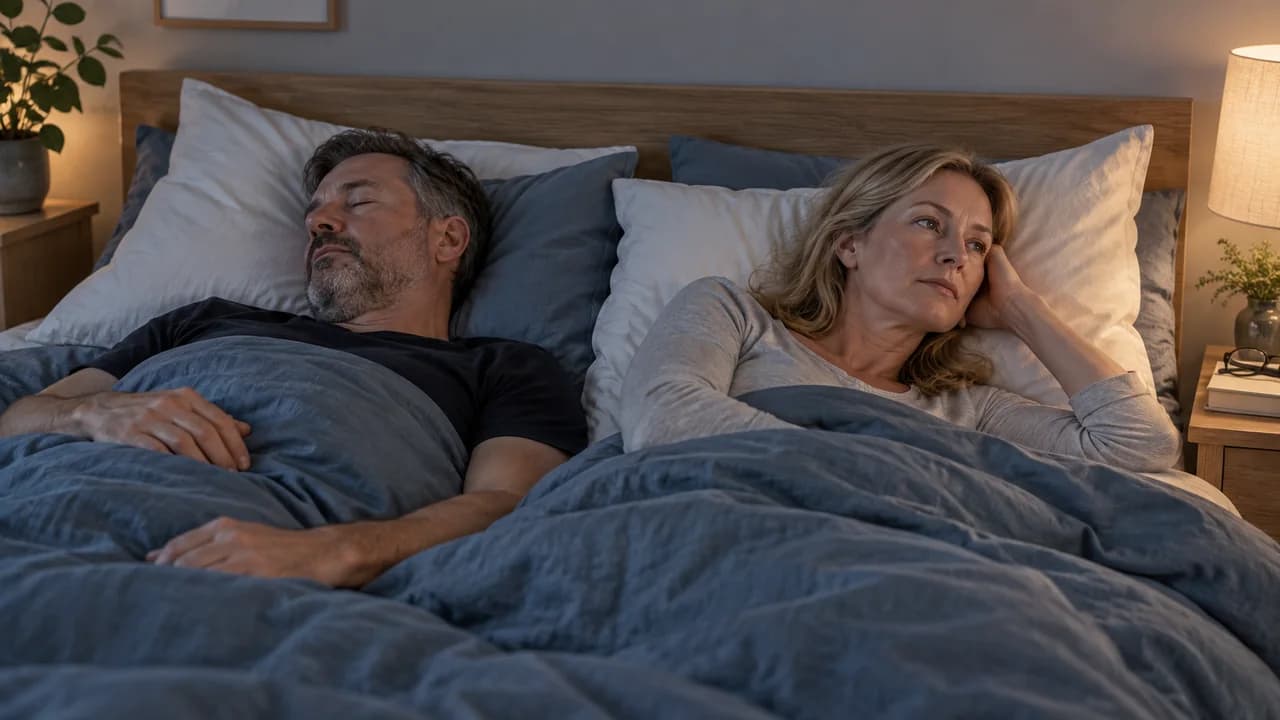
What happens when we snore?
During sleep, muscles relax and the airway may narrow. Air passing through can make soft tissues vibrate. The volume of the sound does not tell you exactly how narrow the airway is or whether breathing pauses occur.
The illustration explains airflow and vibration in general. It does not show your anatomy or establish a diagnosis.
Sources: MedlinePlus: Snoring — adults · NHLBI: What Is Sleep Apnea?
Why does snoring vary from night to night?
Some people notice more snoring when sleeping on their back, when their nose feels blocked or after drinking alcohol. Others have a more persistent problem. Several factors can be involved, so there is no single explanation for everyone.
A brief note about the pattern can help at an appointment. A quieter night is useful information, but it does not prove that a possible breathing disorder has gone away.
Scroll the table horizontally on smaller screens.
| What you notice | A useful question |
|---|---|
| More noise on your back | Does sleeping on your side change it? |
| Frequent nasal congestion | Is it occasional or persistent? |
| Snoring after alcohol | Is this a repeated pattern? |
| A change in symptoms | When did it start, and what else changed? |
Sources: MedlinePlus: Snoring — adults · NHLBI: Treatment
Snoring and sleep apnea are different
In obstructive sleep apnea, the upper airway repeatedly becomes partly or completely blocked during sleep. This can interrupt sleep even when you do not remember waking up. Snoring alone cannot establish the diagnosis.
A partner may notice pauses, gasping or an uneven breathing pattern. Tell your healthcare provider. A phone app that records snoring sounds cannot diagnose or rule out sleep apnea.
Sources: NHLBI: What Is Sleep Apnea? · NHLBI: Diagnosis
What should you do with these observations?
Your primary care provider is a reasonable first contact for breathing pauses or significant sleepiness. It is also reasonable to seek help when snoring disrupts sleep or your relationship, even if nobody has noticed breathing pauses.
Bring a short description from someone who hears you sleep, if available. You do not need extensive nightly measurements. Do not stop prescribed medication on your own.
- Describe how long the problem has lasted.
- Explain how you feel and function during the day.
- Mention what you have tried and what happened.
- Ask when you should return for another assessment.
Make it a shared, specific problem
A conversation during the day is often easier than an argument in the middle of the night. Describe what is happening to your sleep rather than assigning blame. Agree on ways for both of you to rest while you address the problem. Practical arrangements for a partner’s sleep should not replace evaluation of suspected breathing pauses.
What the sound can—and cannot—tell you
“I wake my partner” describes a real burden, but it does not tell you whether airflow stops. “My partner sees me stop breathing” is a different observation to discuss with a clinician. Keeping these descriptions separate makes your account more useful.
A quieter night after trying something new can feel like progress. Keep the original goal in view: were you trying to reduce noise, or treat a diagnosed breathing disorder? Treatment of sleep apnea needs an agreed medical assessment of effectiveness.
If you make an audio recording for your appointment, consider the privacy of anyone sharing the room. You do not need an app or an expensive monitor to ask for help.
Sources: AASM diagnostic testing guideline, 2017, original paper · AASM longitudinal testing guidance, 2021
Notice patterns without diagnosing yourself
Describe whether snoring happens every night or in episodes, whether position changes it and whether your nose feels blocked. These observations add context; they do not locate the problem or identify the right treatment.
“It was quieter on my side” is an observation. “That means I do not have sleep apnea” is a conclusion the observation cannot support. You do not need medical vocabulary to make that distinction.
If snoring determines where you sleep or makes bedtime stressful, mention that too. The goal should reflect daily life, not just a sound level or the number of quiet nights.
Who this guide is for
This guide is for adults who want to understand snoring and find an appropriate starting point. It does not provide an individual assessment for children or during pregnancy. Ask a suitable healthcare professional about those situations; do not apply adult appliance advice to a child.
The information is educational. Your healthcare provider should assess your symptoms and treatment needs.
EXPLORE THE EVIDENCE
Sources and further reading
These sources support the explanations. General information does not replace an individual healthcare assessment.
- NHLBI: What Is Sleep Apnea? Types of sleep apnea, common symptoms and the role of sleep testing.Source checked October 28, 2026
- NHLBI: Symptoms Breathing-related and daytime symptoms that can occur with sleep apnea.Source checked October 28, 2026
- NHLBI: Treatment Treatment options, including lifestyle changes, positive airway pressure and oral devices.Source checked October 28, 2026
- AADSM patient fact sheet Patient information about dental assessment, medical diagnosis and oral appliance care.Source checked October 28, 2026
- MedlinePlus: Snoring — adults Causes of adult snoring, practical measures and symptoms that warrant medical evaluation.Source checked October 28, 2026
- NHLBI: Diagnosis Clinical evaluation, sleep studies and other investigations used to diagnose sleep apnea.Source checked October 28, 2026
- AASM diagnostic testing guideline, 2017, original paper The 2017 adult diagnostic guideline on polysomnography, appropriate home testing and follow-up after unsuccessful home testing.Source checked October 28, 2026
- AASM longitudinal testing guidance, 2021 The 2021 guidance on follow-up sleep testing, including after non-PAP treatments.Source checked October 28, 2026