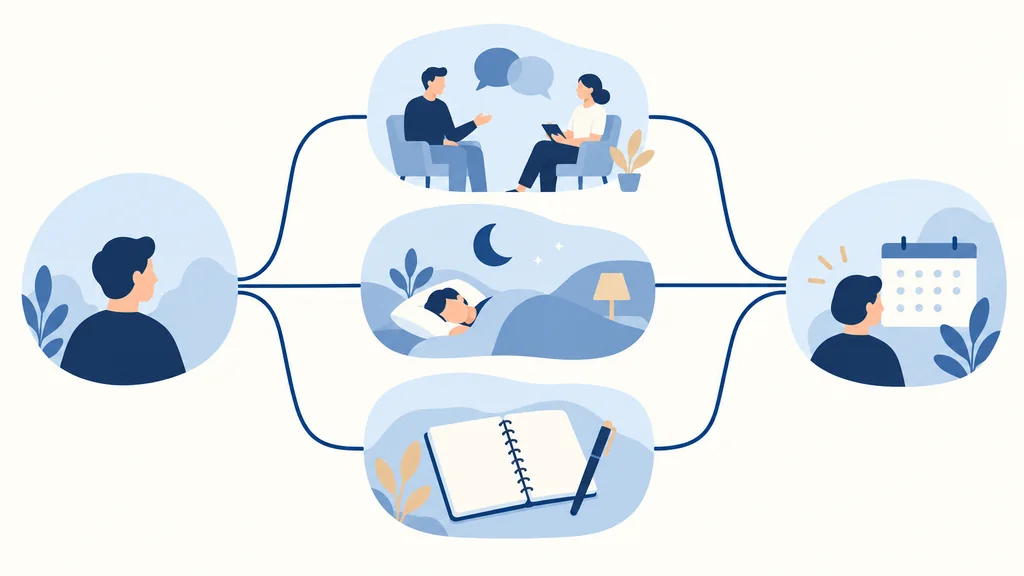
First, what needs to be treated?
A consultation should produce a more specific goal than “stop snoring.” Is the concern disruptive noise, a breathing disorder or both? Ask what is known and what needs further evaluation.
The availability of a product should not determine the investigation. The evaluation should inform the choice, and the provider should explain why an option fits better than the alternatives.
The main options at a glance
Scroll the table horizontally on smaller screens.
| Approach | What it involves | What to keep in mind |
|---|---|---|
| Practical changes | Sleep position and appropriate lifestyle changes | Must not delay evaluation of suspected sleep apnea |
| Oral appliance | A custom device that holds the lower jaw forward | Dental suitability, bite changes and breathing effectiveness require follow-up |
| CPAP and other PAP therapy | Air pressure through a mask | Fitting, maintenance and use over time are central |
| Selected surgery or stimulation | Procedures chosen for an individual clinical situation | Risks, anatomy, eligibility and expected benefit need discussion |
Sources: NHLBI: Treatment · AADSM updated standards, April 2025
CPAP includes training and support
CPAP is a common treatment for obstructive sleep apnea. The mask and treatment settings need appropriate fitting and instructions. If the equipment is difficult to use, discuss it with your care team.
Ask who helps with mask fit, what maintenance is needed and how results will be reviewed. You should not have to solve every technical or practical problem alone.
Sources: NHLBI: Treatment
Oral appliances require dental and breathing assessment
A prescribed custom appliance may be appropriate for selected adults. Teeth, bite and jaw health need assessment. If it is treating OSA, include a plan for checking the breathing response.
Ask which visits the quote covers and how the medical provider and dentist collaborate. Understand possible side effects so you know what to report.
Sources: AADSM updated standards, April 2025 · AASM longitudinal testing guidance, 2021
Position and other individual measures
For some people, symptoms vary with back sleeping. Positional approaches may be worth discussing. Alcohol, smoking and weight can also be relevant to an individual assessment.
General healthy habits and effective treatment of a specific breathing disorder are not the same thing. Ask what a measure is intended to change and how the team will assess whether it is enough. Other options may be appropriate in selected situations; this overview is not an exhaustive treatment list.
Sources: NHLBI: Treatment
Choose with your healthcare provider
Ask: Why this option? What can I realistically expect? What might be difficult? How will we follow up? These answers matter more than a general claim about the “best” treatment.
If the first approach does not work, use what you have learned. Describe both symptoms and practical experiences so the next step has a clear basis.
EXPLORE THE EVIDENCE
Sources and further reading
These sources support the explanations. General information does not replace an individual healthcare assessment.
- NHLBI: Treatment Treatment options, including lifestyle changes, positive airway pressure and oral devices.Source checked October 28, 2026
- AADSM updated standards, April 2025 The 2025 standards for medical and dental collaboration, in-person dental assessment, appliance fitting and ongoing monitoring.Source checked October 28, 2026
- AASM longitudinal testing guidance, 2021 The 2021 guidance on follow-up sleep testing, including after non-PAP treatments.Source checked October 28, 2026