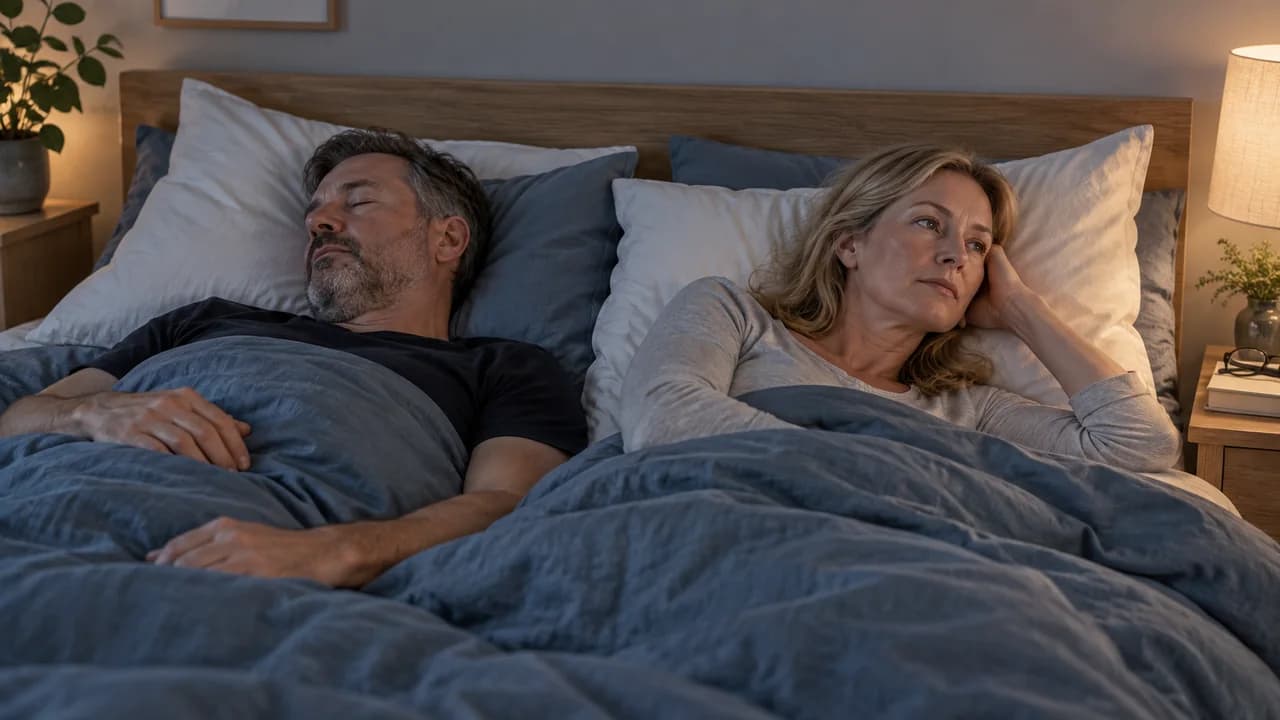
Both people’s sleep belongs in the conversation
The person snoring may feel that the night was ordinary. The person beside them may have been awake repeatedly. Start with those two experiences: what does each of you notice, and what is hardest right now? You do not have to prove how loud the sound is before saying you need sleep.
Separate two questions. One is how to make tonight more manageable. The other is whether the snoring or other signs need evaluation. A temporary sleeping arrangement can help while you address the second question.
Talk when you are awake and have time
Choose a moment when you can finish the conversation. Describe a particular night and its effect on the next day. Then ask how your partner experiences sleep. The following is an illustrative conversation, not a patient story or a treatment technique:
“I have been awake a lot over the last few nights, and I have less energy at work. I know you are not doing this on purpose. Can we make a plan for tonight and talk about what to do next? How do you feel when you wake up?”
If the conversation becomes a dispute about exaggeration, return to the need: “We experience the night differently, but I am not getting enough sleep. I need us to work on a solution together.” You do not have to agree on the cause to agree on a next step.
Describe
Say what you noticed and how it affected you. Avoid “always,” “never” and guesses about motives.
Ask
Give your partner space to describe their night and daytime experience. Do not assume you notice the same things.
Agree
Choose a practical arrangement for tonight and a time to revisit it. Clarify who will contact a healthcare provider if needed.
Make a nighttime agreement that considers both of you
If separate sleeping spaces are available, you can agree to use them temporarily and decide when to review the arrangement. Discuss who uses which space and what to do if someone remains awake. This arrangement does not explain the cause of the snoring.
A quieter sleeping space or appropriate hearing protection may make the sound less disruptive for a partner; make sure important alarms or responsibilities can still be managed. Sleeping on the side can help some people. These practical choices do not establish that a breathing disorder is controlled.
Avoid turning every night into a project in which one person monitors the other. Try a manageable arrangement and discuss how both of you slept. If you have noticed breathing pauses or other concerning signs, arrange medical contact as a separate step, regardless of whether the room becomes quieter.
Sources: NHLBI: Treatment · AASM diagnostic testing guideline, 2017, original paper
Describe what you notice without treating it as a diagnosis
Some sleep apnea signs are noticed by another person: breathing that seems to stop and restart, gasping or frequent awakenings. The person snoring can describe daytime sleepiness or concentration problems. Keep what you saw or heard separate from what your partner reports.
Note what you happen to notice. Do not stay awake to count pauses or estimate severity. These prompts have no score or diagnostic threshold. A night without observed signs does not reliably rule out a problem.
Scroll the table horizontally on smaller screens.
| Topic | Questions you can use |
|---|---|
| Your own sleep | Did the sound wake you? Was it hard to return to sleep, and how did you feel the next day? |
| What you heard or saw | Was there snoring, gasping or a pause? Use your own words and say when you are unsure. |
| Pattern and context | Have you noticed it on other nights? Did either of you notice a particular position or nasal congestion? |
| Your partner’s day | Do they feel rested, or describe sleepiness and difficulty concentrating? |
Sources: NHLBI: Symptoms · AASM diagnostic testing guideline, 2017, original paper
When should your partner contact a healthcare provider?
Observed breathing pauses, gasping or significant daytime sleepiness are reasons to contact a primary care provider or another appropriate clinician. Snoring that substantially affects either person’s everyday life is also worth discussing. You do not have to gather many nights of notes first.
Snoring alone does not diagnose sleep apnea. A phone app, smartwatch or sound recording cannot replace a clinical assessment and the appropriate sleep test. Explain uncertainty rather than trying to settle what it means beforehand.
If you both want to, you can attend the appointment and describe your observations. Your partner can also bring the notes. Offering useful information does not make you responsible for managing their evaluation.
Sources: NHLBI: Symptoms · NHLBI: Diagnosis · AASM diagnostic testing guideline, 2017, original paper
A simple note sheet to take along
Copy these prompts into your own notes or print the page and use the blank rows. Keep it short and distinguish “I heard,” “I saw” and “my partner told me.” It is fine to write “unsure” or leave a space blank. There is no required number of nights before seeking help.
This is a blank print worksheet. Nothing is submitted, recorded or saved on the website. Keep the notes yourself and decide together what your partner wants to share with a healthcare professional.
Scroll the table horizontally on smaller screens.
| Date / night | Who noticed what? | Pattern or context | How was the next day? |
|---|---|---|---|
| Note 1 | |||
| Note 2 | |||
| Note 3 |
Prepare a few questions for the appointment
A brief description is easier to start with than a long sheet of conclusions. Use this list and skip anything irrelevant:
- What does your partner want help with, and how do the nights affect each of you?
- What was observed, by whom, and roughly when did it begin?
- What has your partner tried, and what did they notice afterward?
- Does this need further testing, and how will they receive the results and next steps?
- Whom should they contact if symptoms persist or the situation changes?
If your partner does not want to act
You can invite a conversation and offer practical help, but you cannot make your partner’s decisions. Ask what makes the next step difficult: uncertainty about the appointment, lack of time or experiencing the problem differently. Listen before suggesting a solution.
You can still be clear about your needs: “I would like to sleep together, but I need a different arrangement on nights when I cannot sleep.” You do not need to put your own rest on hold while you reach agreement. If your sleep and daytime life are significantly affected, discuss that with your own healthcare provider.
EXPLORE THE EVIDENCE
Sources and further reading
These sources support the explanations. General information does not replace an individual healthcare assessment.
- NHLBI: Symptoms Breathing-related and daytime symptoms that can occur with sleep apnea.Source checked October 28, 2026
- NHLBI: Diagnosis Clinical evaluation, sleep studies and other investigations used to diagnose sleep apnea.Source checked October 28, 2026
- NHLBI: Treatment Treatment options, including lifestyle changes, positive airway pressure and oral devices.Source checked October 28, 2026
- AASM diagnostic testing guideline, 2017, original paper The 2017 adult diagnostic guideline on polysomnography, appropriate home testing and follow-up after unsuccessful home testing.Source checked October 28, 2026